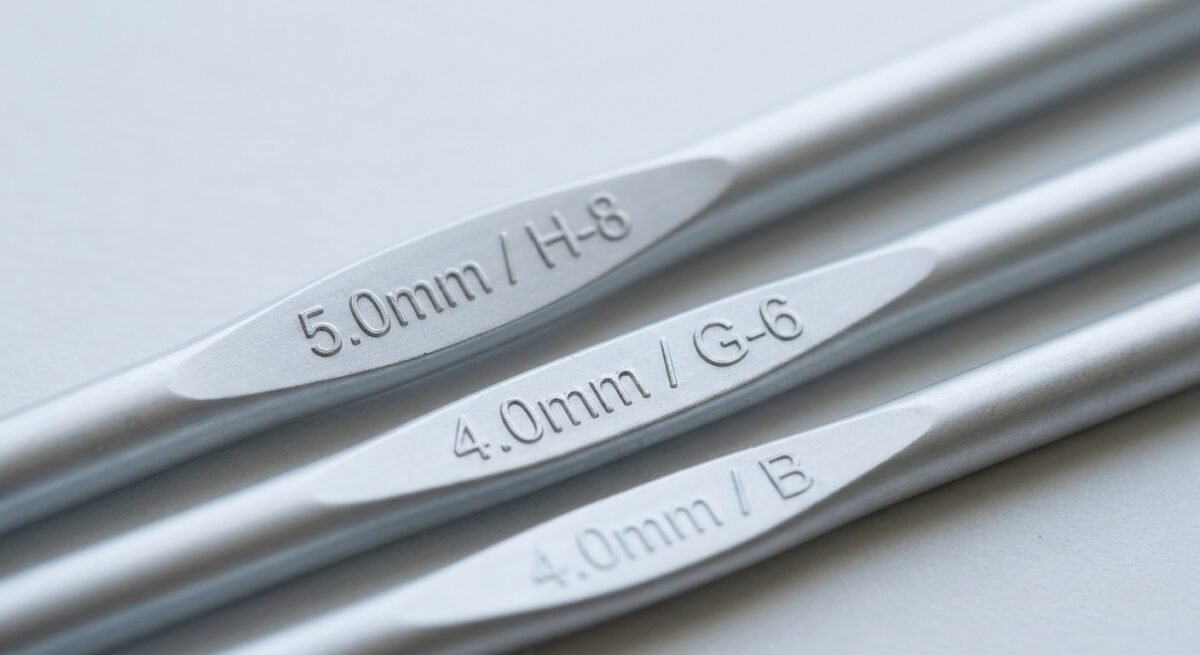
Free crochet hook size chart with US, UK and metric conversions, yarn weight pairings, and tips for choosing the right hook for any project.
You open a new pattern and it says “use a size H-8 hook.” You look at your hooks and they’re marked 5 mm, or 6, or just a number with no letter at all. Which one is it?
Crochet hook sizes are labeled in three different systems, and they don’t line up neatly. This crochet hook size chart puts US, UK and metric sizes side by side, then shows you how to match hooks to yarn, pick the right one for your project, and fix common sizing problems.
Crochet Hook Size Chart
Bookmark this one. It covers the standard hook sizes you’ll find in most craft stores.
| Metric (mm) | US Size | UK/Canada Size |
|---|---|---|
| 2.0 mm | none (steel/fine) | 14 |
| 2.25 mm | B-1 | 13 |
| 2.75 mm | C-2 | 12 |
| 3.0 mm | none | 11 |
| 3.25 mm | D-3 | 10 |
| 3.5 mm | E-4 | 9 |
| 3.75 mm | F-5 | 9 |
| 4 mm | G-6 | 8 |
| 4.5 mm | 7 | 7 |
| 5 mm | H-8 | 6 |
| 5.5 mm | I-9 | 5 |
| 6 mm | J-10 | 4 |
| 6.5 mm | K-10½ | 3 |
| 8 mm | L-11 | 0 |
| 9 mm | M/N-13 | 00 |
| 10 mm | N/P-15 | 000 |
| 15 mm | P/Q | n/a |
Important: sizes vary slightly between brands, and some hooks carry only a millimeter size or only a letter. Always check the mm marking on your hook, and when brands disagree, trust the millimeters.
How to Read a Crochet Hook Size Chart
Each row of the chart is one hook, listed in the three systems used around the world.
Metric (mm). This is the diameter of the hook’s shaft, the part that determines how large your stitches will be. Because it’s an actual measurement, it’s the most dependable system, and it’s the same in every country.
US sizes. These use a letter and number together (like H-8), though some hooks show only one or the other. The letters run from B up, and the numbers run alongside them. Because brands don’t always agree on the pairing, a US “I” from one maker can be slightly different from another’s.
UK/Canadian sizes. Older UK sizing is a number system that runs backwards: the smaller the number, the bigger the hook. A UK 4 is larger than a UK 8. Many UK patterns have moved to metric, but you’ll still see the old sizes in vintage patterns.
Steel hooks. Very fine hooks used for thread crochet, like doilies and lace, use their own numbering. Larger numbers are smaller hooks, and the sizes run well below 2 mm. If you’re working with thread, check that the pattern says whether it means steel or standard hooks.
Quick tip: If a pattern lists only one system, find that size in the chart, then confirm the mm size. Write the mm size in the margin so you don’t have to look it up again.
Crochet Hook Sizes and Yarn Weight Guide
Hook size and yarn weight go together. The thicker the yarn, the larger the hook you’ll generally need. Most yarn labels show a number from 0 to 7 in a small skein symbol, which is the Craft Yarn Council’s standard weight system.
| Yarn Weight | Category | Common Names | Typical Hook Size |
|---|---|---|---|
| 0 | Lace | Thread, crochet cotton, fingering (fine) | 1.6-2.25 mm |
| 1 | Super Fine | Fingering, sock, baby | 2.25-3.5 mm |
| 2 | Fine | Sport, baby | 3.5-4.5 mm |
| 3 | Light | DK, light worsted | 4.5-5.5 mm |
| 4 | Medium | Worsted, afghan, aran | 5.5-6.5 mm |
| 5 | Bulky | Chunky, craft, rug | 6.5-9 mm |
| 6 | Super Bulky | Super chunky, roving | 9-15 mm |
| 7 | Jumbo | Jumbo, roving | 15 mm and up |
These ranges are starting points, not rules. They’re based on what produces a fabric with a comfortable drape, and your project may need something different (more on that below).
Two terms that cause confusion: DK and light worsted are both weight 3, and aran and worsted are both weight 4, even though the names differ by country. If your yarn label has no number, compare the yardage per 100 g: more yardage means thinner yarn.
How to Choose the Right Crochet Hook Size
Choosing a hook is a short process once you know the steps.
- Start with the pattern. The designer chose a hook to match the stitch pattern and the gauge, so begin there.
- Check the yarn label. It will recommend a hook range. Use it as a cross-check, especially if you’re substituting yarn.
- Work a gauge swatch. Crochet a square of about 4 x 4 inches (10 x 10 cm) in the stitch pattern and measure how many stitches and rows fit. Too many stitches per inch means your work is too small, so go up a hook size. Too few means it’s too large, so go down.
- Think about the fabric you want. A larger hook makes a softer, drapier, more open fabric. A smaller hook makes a denser, stiffer, more structured one.
- Factor in your own tension. Tight crocheters often need to go up a size, and loose crocheters often need to go down. It’s one of the main reasons two people can follow the same pattern and get different results.
Hook material matters too. Aluminum hooks are smooth and fast, which is great for slippery or splitty yarn, but can feel cold. Bamboo and wood grip the yarn more and slow you down slightly, which many beginners like. Plastic is lightweight and budget-friendly. Ergonomic handles help if your hands tire easily.
Hook shape matters. Tapered (or “pointed”) heads slide easily into stitches and suit fine work. Inline hooks have a flatter head that holds the yarn more securely and gives very even stitches. Neither is better, so try both.
Crochet Hook Size Chart for Beginners
If you’re just starting, don’t overthink it. A 5 mm to 6 mm hook (H-8 to J-10) with worsted weight (4) yarn is the sweet spot:
- Stitches are big enough to see clearly.
- It’s easy to spot and fix mistakes.
- Projects grow quickly, which keeps you motivated.
- Worsted yarn is widely available and affordable.
What to avoid at first:
- Very thin thread or lace-weight yarn (hard to see stitches)
- Fuzzy or mohair yarn (hard to see where to insert the hook)
- Very dark colors (stitches disappear)
- Very slippery yarn (it slides off the hook)
Best beginner yarn: a smooth, light-colored cotton or acrylic blend in worsted weight. Light colors make stitches easy to read, and smooth yarn makes it easy to rip back and try again.
A starter set to consider: a 4 mm, 5 mm and 6 mm hook will cover most beginner projects, like dishcloths, scarves and simple hats.
Best Crochet Hook Size for Different Projects
Different projects call for different fabrics, so the hook you want isn’t always the one on the label.
| Project | Suggested Hook | Why |
|---|---|---|
| Amigurumi (stuffed toys) | 2.5-3.5 mm | A smaller hook than the yarn suggests makes tight stitches, so stuffing doesn’t show through |
| Blankets | 5.5-6.5 mm (worsted) | Soft drape without being too loose |
| Scarves | 4.5-6 mm | Drape is key, so match the hook to the yarn weight |
| Hats | 4.5-5.5 mm | Firm enough to hold its shape |
| Sweaters/cardigans | Per pattern | Gauge is critical, so always swatch |
| Socks | 2.25-3.5 mm | Dense fabric that wears well |
| Lace and doilies | 1.6-2.25 mm (thread) | Fine detail needs a fine hook |
| Market bags and baskets | 3.5-4.5 mm | A tight stitch resists stretching |
| Chunky throws | 8-15 mm | Big stitches work up fast |
| Washcloths and dishcloths | 3.5-5 mm | Dense fabric scrubs better |
Rule of thumb: for projects that need to hold their shape (toys, bags, baskets), go down a hook size or two from the label. For projects that should drape (shawls, scarves, blankets), stay at or go up from the label.
What Happens If You Use the Wrong Crochet Hook Size?
A hook that’s a size or two off won’t ruin a scarf, but it will change fit, drape, yarn usage and comfort.
If your hook is too small:
- The fabric turns out stiff and tight.
- Your hands may cramp from forcing the hook through stitches.
- The finished piece comes out smaller than the pattern says.
- You may run out of yarn sooner than expected, since stitches are denser.
If your hook is too large:
- The fabric turns out loose, floppy and full of gaps.
- Wearables may sag or stretch out of shape.
- The finished piece comes out larger than the pattern says.
- Toys may show stuffing through the gaps.
The fix is simple: work a gauge swatch every time you start a project that needs to fit, like garments, hats and gloves. It takes ten minutes and can save you hours of frogging (ripping out stitches).
Common mistake: assuming the label hook is always right. Labels are an average. Your tension, stitch pattern and the project’s purpose should all weigh in.
Frequently Asked Questions
How do I know what size crochet hook to use?
Start with the hook recommended in your pattern. If the pattern doesn’t say, check your yarn label for its suggested range. Then crochet a gauge swatch: if your swatch is smaller than the pattern’s gauge, go up a hook size, and if it’s larger, go down.
What is the most common crochet hook size?
The H-8 (5 mm) is the most widely used, along with the G-6 (4 mm) and I-9 (5.5 mm). These pair well with worsted and DK weight yarns, which are the most popular weights.
Are US and UK crochet hook sizes different?
Yes. US sizes use letters and numbers (like H-8), where bigger usually means a bigger hook. Older UK sizes use a number system that runs the opposite way, where smaller numbers mean bigger hooks. The metric (mm) size is the same everywhere, so it’s the safest way to compare.
What size crochet hook is best for beginners?
A 5 mm to 6 mm hook (H-8 to J-10) with worsted weight yarn is the easiest starting point. Stitches are easy to see, and projects work up quickly.
How do I convert crochet hook sizes to millimeters?
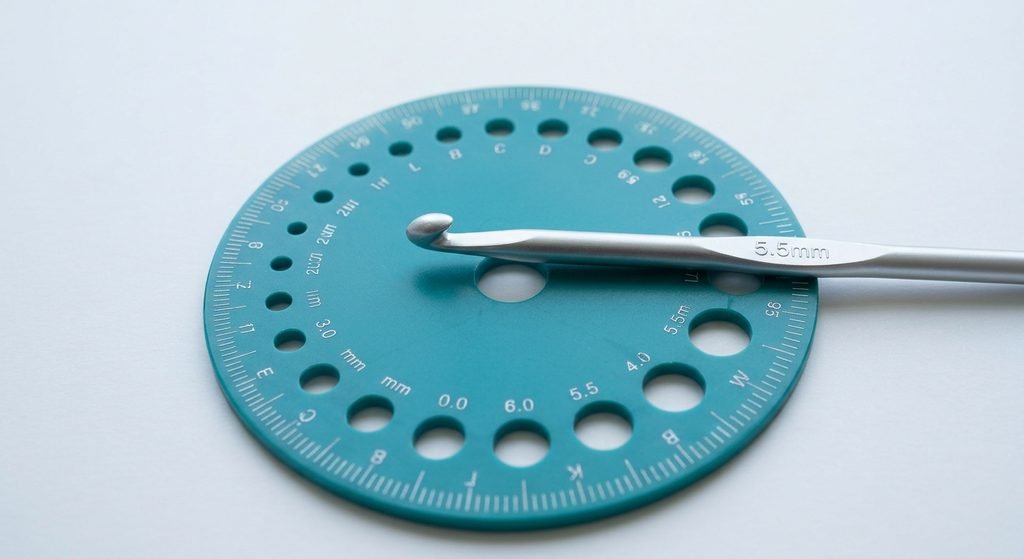
Find your US or UK size in the chart above and read across to the metric column. If your hook has no markings, use a hook gauge, a small tool with sized holes that tells you the exact size in mm.
Can I use a different hook size than the pattern says?
Yes, if you check your gauge. Changing hook size changes your stitch size, so always swatch first. Adjusting the hook is also a common way to match a pattern’s gauge when your tension differs from the designer’s.
Do I need different hooks for different yarns?
You don’t need a hook for every yarn weight, but a range of sizes helps. A set covering 2.5 mm to 6 mm handles most projects.
More Crochet Projects
Crochet Newborn Blanket –> https://cozyknotty.com/crochet-newborn-blanket/
Crochet Flowers —> https://cozyknotty.com/crochet-flower/